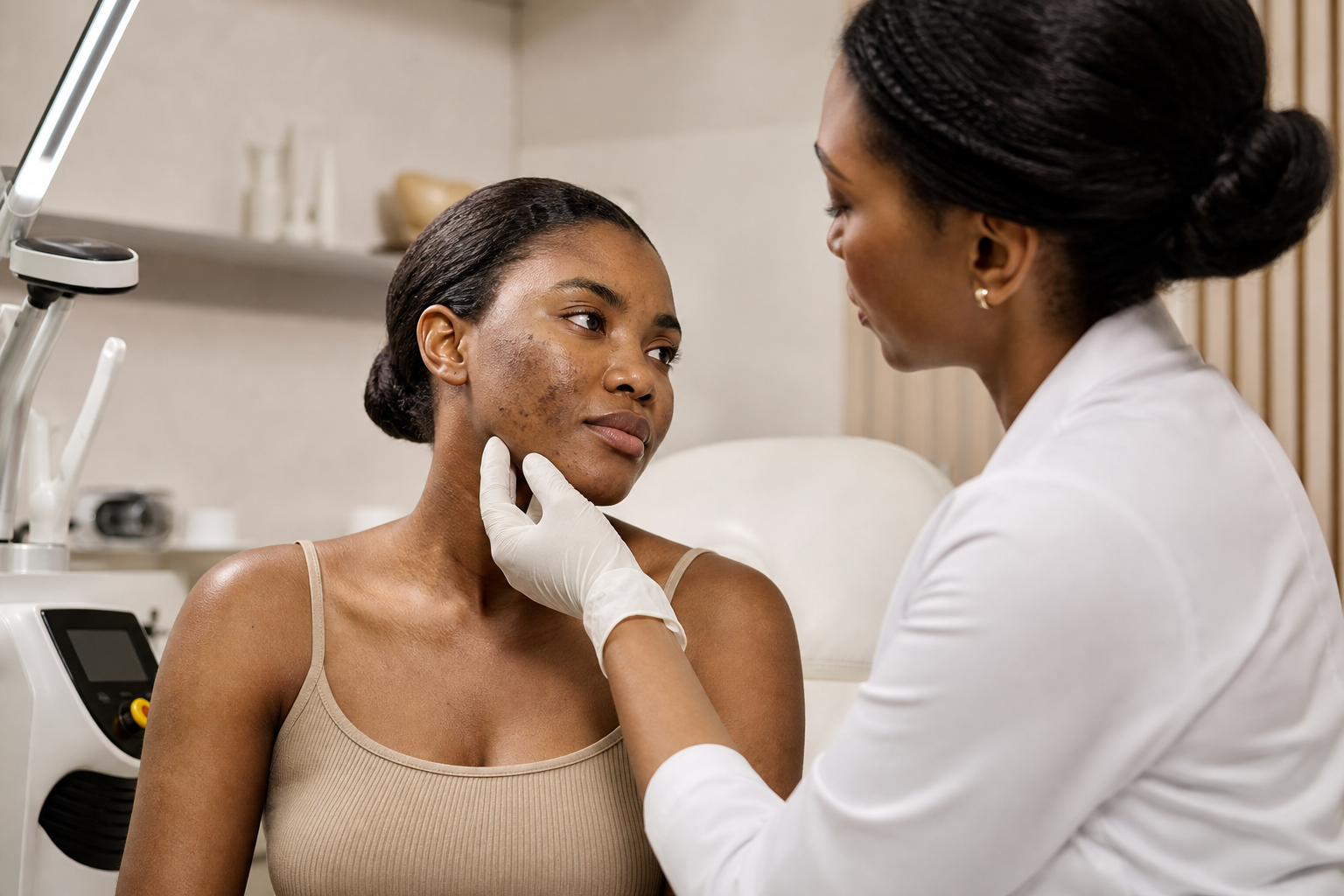
Laser treatment for post-acne marks in darker skin is a nuanced and increasingly vital area of dermatological and aesthetic care. Post-acne marks, often manifesting as dark spots or uneven pigmentation, are a common cosmetic concern for individuals with darker skin tones. These marks, medically defined as post-inflammatory hyperpigmentation (PIH), are not mere surface discolorations but reflections of the skin's response to inflammation and injury. The rich melanin content characteristic of darker skin types presents both challenges and opportunities when addressing PIH through laser therapy.
Understanding laser treatment in this context is crucial for those affected by post-acne marks and for professionals specializing in skin care and laser procedures. This editorial uncovers the complexities involved in treating PIH in darker phototypes, emphasizing the importance of distinguishing between brown PIH and red post-inflammatory erythema. It also highlights why controlling active inflammation is fundamental prior to laser intervention, and why caution is paramount due to the risk of laser-induced darkening or paradoxical hyperpigmentation.
Why does this topic matter? Post-acne hyperpigmentation can significantly impact self-esteem and quality of life. However, the response to laser treatments varies widely among skin types, and without careful customization, interventions may inadvertently exacerbate pigmentation or injury. Thus, informed selection of laser modalities, timing, and adjunctive therapies is essential to achieve safe and effective pigment correction in darker skin tones.
What Differentiates Brown PIH from Red Post-Inflammatory Erythema?
The initial and crucial step in managing post-acne marks involves differentiating between brown PIH and red post-inflammatory erythema, as their underlying mechanisms and treatment approaches differ markedly. Brown PIH arises from an overproduction and irregular dispersion of melanin following inflammation. This pigmentary change is more pronounced and persistent in individuals with darker skin due to the higher baseline melanin and heightened melanocyte activity. It typically appears as well-demarcated brown spots or patches that may persist from months to years.
Conversely, red post-inflammatory erythema results from dilated or damaged capillaries and blood vessels beneath the skin's surface. This vascular response manifests as pink to red discoloration and usually reflects ongoing low-grade inflammation or vascular instability. Unlike brown PIH, red erythema often resolves naturally over time as the inflammation subsides.
Recognizing the distinction between these two is key because laser treatments target fundamentally different chromophores: vascular lasers act on hemoglobin to reduce erythema, while pigment-specific lasers target melanin to lighten hyperpigmented lesions. Misclassification may lead to ineffective or detrimental treatment outcomes.
Who Is Best Suited for Laser Treatment of Post-Acne Marks in Darker Skin?
Individuals with Fitzpatrick skin types IV through VI, encompassing a vast diversity of darker skin tones, often face greater challenges with persistent post-acne hyperpigmentation. This population frequently seeks interventions to improve skin homogeneity and brightness but must proceed with tailored treatment plans that consider intrinsic melanin levels and skin sensitivities.
Laser therapy candidates should ideally have stable and controlled skin without active inflammation or infection. It is imperative that acne lesions are quiescent before initiating laser sessions to minimize risks of exacerbating pigmentation or provoking new skin injury. Moreover, patients who understand the importance of post-treatment care—including strict sun protection and appropriate skincare regimens—are more likely to benefit from laser procedures.
For practitioners, successful treatment demands deep expertise in laser-tissue interactions in darker skin, knowledge of varied laser devices and settings, and an ability to monitor and respond to patient-specific responses throughout a multi-session course.
Why Is Laser Treatment Complex in Darker Phototypes?
Laser treatment in darker skin phototypes presents unique challenges mainly due to melanin’s dual role as a chromophore and as a risk factor. Melanin's broad absorption spectrum means that laser energy aimed at pigment spots can inadvertently stimulate melanocytes, causing increased melanin production rather than reduction. This phenomenon, termed laser-induced hyperpigmentation (LIP) or paradoxical pigmentation, poses a substantial obstacle to achieving optimal outcomes.
Moreover, darker skin is less forgiving of epidermal injury. Even minor disruptions may trigger prolonged inflammation and subsequent exacerbation of PIH. Hence, lasers must be chosen and calibrated to deliver sufficient energy to break down pigment while minimizing collateral thermal damage.
Another critical aspect is the variability of individual skin responses. Factors like genetic predisposition, concurrent dermatologic conditions, and prior treatments influence both efficacy and safety profiles. Historically, many laser protocols were developed based on lighter skin phototypes, underscoring the necessity for ongoing clinical innovation and adaptation to darker skins.
How Do Different Laser Technologies Work in Treating Post-Acne Marks in Darker Skin?
A range of laser technologies is employed for the management of PIH and associated acne marks, with selections carefully guided by the lesion characteristics and skin type. Picosecond lasers, emitting ultra-short pulses in picosecond durations, have gained prominence for their precision in targeting pigment particles with minimal thermal diffusion. This precision diminishes collateral epidermal injury and reduces risks of worsening hyperpigmentation in dark skin.
Fractional lasers, both ablative and non-ablative, offer the advantage of stimulating dermal remodeling as well as pigment clearance. By creating controlled micro-injuries surrounded by untreated skin, fractional lasers foster rapid healing and incrementally improve skin texture and pigmentation. However, treatment parameters must be conservatively adjusted to avoid overt epidermal disruption in highly pigmented skin.
Vascular lasers, such as pulsed dye lasers, specifically address red post-inflammatory erythema by targeting hemoglobin within dilated vessels. In cases where both brown and red marks coexist, a combination of laser modalities or staged treatments may be indicated.
In all instances, pre-treatment skin preparation—sometimes including topical depigmenting agents—and post-treatment care are integral to optimizing laser effects.
When Is the Optimal Time to Initiate Laser Therapy for Post-Acne Pigmentation in Darker Skin?
Timing laser therapy requires strategic consideration of the skin’s inflammatory status and healing dynamics. Active acne inflammation necessitates management before any laser intervention to reduce the risk of exacerbating both acne lesions and pigment changes. Typically, a waiting period of several weeks to months after lesion resolution allows the skin surface to stabilize.
In clinical practice, dermatologists often advocate initial conservative approaches employing topical agents such as hydroquinone, retinoids, or chemical exfoliants to mildly improve pigmentation. Only once the skin demonstrates minimal active inflammation and tolerance to treatments should laser therapy commence.
Patient counseling on the potential prolonged nature of treatment and the importance of photoprotection is crucial. Sun exposure can not only worsen existing PIH but also provoke laser-induced pigmentation if not meticulously managed.
What Are Realistic Expectations Regarding Results and Recovery?
Patients considering laser treatment for post-acne marks in darker skin should approach the process with measured expectations. While laser therapy can significantly improve hyperpigmentation and skin texture, results are typically incremental and may require multiple sessions spaced over weeks or months.
The recovery period varies by laser type and treatment intensity but often involves transient redness, slight swelling, and mild peeling. These effects usually resolve within days but necessitate careful skin care and sun avoidance to prevent adverse events.
Complete clearance of pigmentation is rarely immediate or guaranteed. Maintenance treatments, ongoing skincare, and sun protection remain essential to uphold and enhance therapeutic gains. Importantly, any treatment plan must balance efficacious pigment reduction with the preservation of skin integrity to prevent post-procedure complications.
Frequently Asked Questions About Laser Treatment for Post-Acne Marks on Darker Skin
Can laser treatment worsen post-inflammatory hyperpigmentation? Indeed, improper laser settings or treating inflamed skin can provoke paradoxical hyperpigmentation. This risk underscores the need for expert assessment and personalized protocols.
Which laser types are safest and most effective for darker skin? Picosecond lasers and carefully administered fractional lasers tend to demonstrate favorable safety profiles. Vascular lasers help address red marks but must be selected cautiously.
Are adjunctive treatments necessary alongside laser therapy? Combining laser treatment with topical depigmenting agents, exfoliants, and rigorous sun protection enhances outcomes and reduces recurrence risks.
How many treatment sessions are typically required? Multiple sessions—often between three to six—are common, tailored according to lesion severity and individual response.


