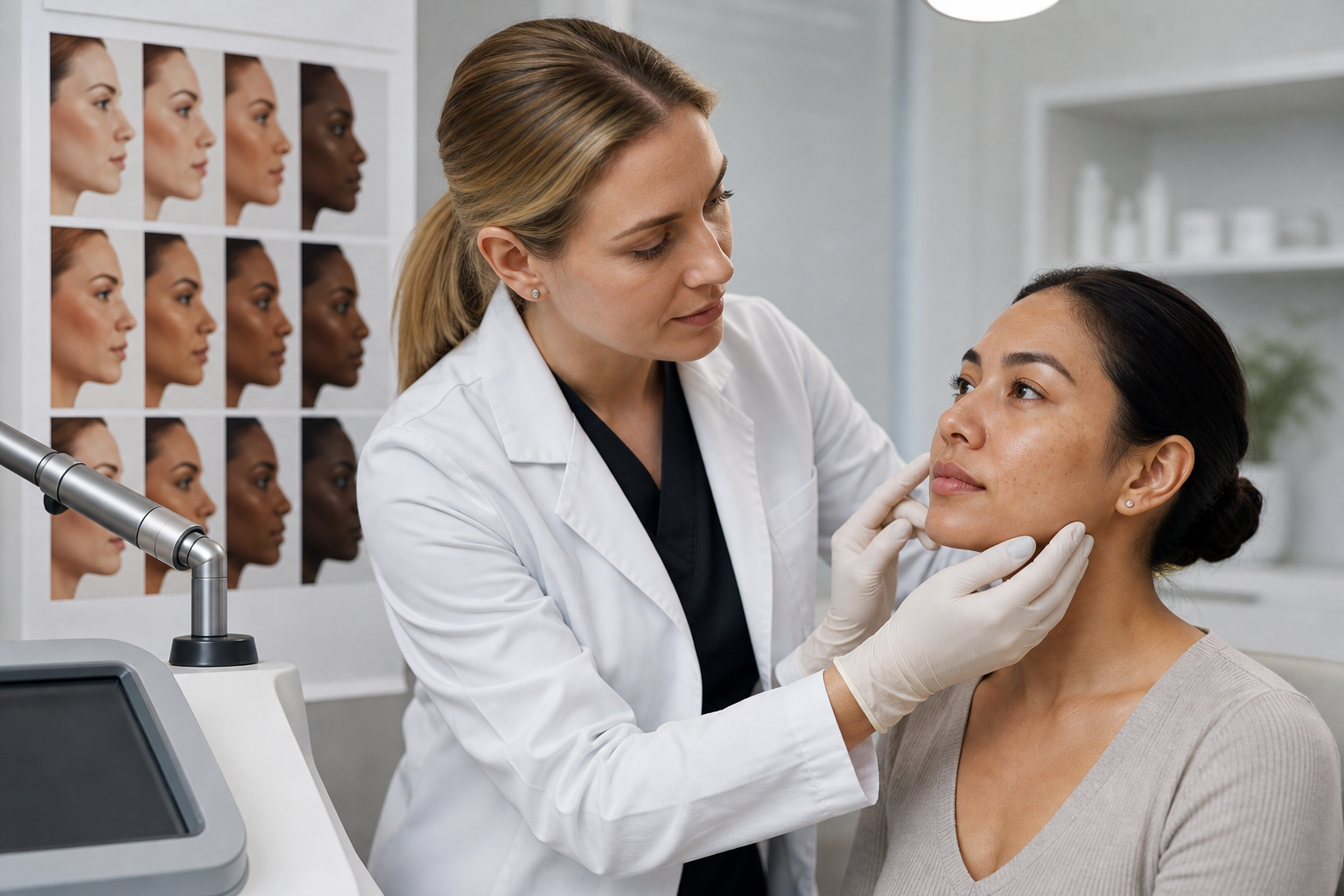
The Fitzpatrick skin type classification system is a fundamental tool in dermatology and aesthetic medicine, particularly when selecting appropriate laser treatments for pigmentation issues. Originating as a method to gauge skin's reaction to ultraviolet (UV) radiation, this classification has evolved into an essential framework guiding clinicians in customizing laser procedures to maximize safety and effectiveness for patients with diverse skin tones. Understanding the Fitzpatrick skin type not only helps reduce adverse effects but also enhances treatment outcomes, thereby making it a critical consideration for dermatologists, aesthetic practitioners, and patients embarking on laser pigmentation therapies.
This article explores the significance of Fitzpatrick skin typing in the context of laser selection for pigmentation removal. It presents a detailed overview of how skin phototypes influence laser-tissue interaction, the risks involved—especially for darker and tanned skin phototypes—and provides practical insights into preventing complications. While educational in nature, this discussion underscores that patient safety and treatment customization hinge on expert clinical evaluation. Hence, a qualified healthcare provider's assessment remains indispensable for any laser pigmentation procedure.
Laser treatments addressing pigmentation irregularities—such as melasma, age spots, post-inflammatory hyperpigmentation, and uneven skin tone—are increasingly sought after across all skin types. Successful therapy requires a nuanced approach that integrates the Fitzpatrick phototype to select laser wavelengths, pulse durations, and energy levels tailored to an individual's unique skin characteristics. This stratagem minimizes risks like post-inflammatory hyperpigmentation, hypopigmentation, or scarring, which occur with greater frequency in certain phototypes. As such, this guide aims to elucidate the interplay between Fitzpatrick classification and laser choice, emphasizing patient and device factors essential in striking a balance between efficacy and safety.
What Is the Fitzpatrick Skin Type and Why Is It Crucial for Laser Pigmentation Treatment?
The Fitzpatrick skin phototype system, developed by Dr. Thomas B. Fitzpatrick in 1975, classifies human skin into six types based on their susceptibility to UV-induced erythema and tanning response. Types range from I, characterized by very fair skin that burns easily and tans minimally, to VI, denoting deeply pigmented dark brown to black skin that rarely burns and tans profusely. This classification provides a standardized lens through which skin's pigmentary composition and photoreactivity are assessed.
Its importance in laser pigmentation treatment lies in how different phototypes absorb and respond to laser energy. Melanin, the skin pigment targeted during pigmentation correction, varies in concentration and distribution across Fitzpatrick types. Lighter phototypes have lower melanin density, making them more responsive and less prone to certain complications. In contrast, darker skin types with abundant melanin present challenges: laser energy may indiscriminately affect both pathological pigment and surrounding normal melanin-rich tissue, raising the risk of treatment-induced pigmentary alterations or injury.
Consequently, Fitzpatrick skin typing is not merely an academic classification, but a clinical compass directing the selection of laser parameters—wavelengths, pulse durations, and fluence—to optimize outcomes while curtailing adverse events. For patients and practitioners alike, acknowledging this foundation enhances informed decision-making and tailored therapeutic planning.
Who Are Suitable Candidates for Laser Pigmentation Treatments According to Fitzpatrick Skin Types?
Laser pigmentation treatments appeal to individuals with various skin types who suffer from stubborn pigmentary concerns such as melasma, sunspots, lentigines, or post-inflammatory hyperpigmentation. Nonetheless, candidacy hinges on more than the isolated presence of pigmentation; understanding the patient's Fitzpatrick skin type informs suitability and risk profiles.
Individuals with Fitzpatrick skin types I through III, predominantly lighter skin tones, generally tolerate a wider range of laser modalities safely. Their lower baseline melanin reduces the likelihood of laser-induced pigmentary side effects. Therefore, these patients often have access to an extensive toolkit of lasers, including devices emitting visible and near-infrared wavelengths, allowing precise targeting of pigmented lesions with relative ease.
Conversely, those with Fitzpatrick types IV through VI—darker skin phototypes—require meticulous consideration. High melanin density exhibits increased light absorption, raising the risk of post-procedural complications such as hyperpigmentation or hypopigmentation if inappropriate lasers or parameters are used. Furthermore, patients with darker skin who have recently tanned pose even greater challenges, as transient melanin elevation alters laser-tissue interactions unpredictably.
Therefore, while laser pigmentation treatment is broadly accessible across skin types, individuals with darker or recently sun-exposed skin benefit from careful clinical evaluation and bespoke treatment protocols designed to mitigate increased susceptibility to adverse effects.
How Does Fitzpatrick Skin Type Influence Laser Selection and Treatment Parameters?
Laser light interacts preferentially with specific chromophores—pigments in the skin—chief among them being melanin. The Fitzpatrick skin type influences the density and distribution of melanin, which governs how laser energy is absorbed and dispersed within the skin. This dynamic profoundly affects laser selection and parameter optimization.
For lighter skin types (I–III), lasers emitting shorter wavelengths—such as the Alexandrite laser at 755 nm—can be highly effective. These wavelengths are strongly absorbed by melanin within pigmented lesions yet spare surrounding tissue due to relatively low background pigmentation. Pulse durations and fluence levels can be moderately aggressive to ensure lesion clearance with minimal risk.
For darker skin types (IV–VI), longer wavelengths like the Nd:YAG laser at 1064 nm are preferred. This wavelength penetrates deeper with less melanin absorption in the epidermis, reducing the risk of epidermal damage and post-treatment hypopigmentation or hyperpigmentation. Moreover, parameters such as pulse duration and fluence must be carefully subdued to avoid excessive thermal injury. Practitioners often employ test spots and conservative initial settings, incrementally adapting based on patient response.
Beyond wavelength, device technology also plays a role. Q-switched lasers, Picosecond lasers, and fractional lasers each have varying mechanisms of pigment fragmentation and collateral tissue impact. Their use depends on integrating Fitzpatrick type considerations with lesion type and location.
What Are the Potential Risks Associated with Laser Pigmentation Treatment Relative to Fitzpatrick Skin Types?
Laser treatments, while efficacious, carry inherent risks that correlate intimately with Fitzpatrick skin classification. Understanding these risks is imperative for risk mitigation and patient counseling.
Post-Inflammatory Hyperpigmentation (PIH) is among the most prevalent concerns, particularly in types IV to VI. PIH manifests as darkened patches where the treatment induced inflammatory responses, stimulating melanocytes to produce excess pigment. Its resolution can be prolonged, and it sometimes surpasses the original pigmentation in prominence.
Hypopigmentation, or lightening of the skin, occurs less frequently but poses significant aesthetic distress due to the difficulty in restoring uniform pigment once melanocytes are damaged or destroyed. This risk escalates with overly aggressive treatment or inappropriate laser choice in darker skin.
Scarring and textural changes, although less common with modern devices and techniques, remain possible complications, especially if pre-existing skin conditions or improper laser parameters are involved. Their occurrence underscores the necessity of precision and experience in procedural execution.
Mild, transient side effects like erythema, edema, or discomfort are typical but usually resolve without sequelae if treatments are properly performed and aftercare adhered to.
How Can Safety Be Maximized and Complications Prevented Considering Fitzpatrick Skin Types?
Ensuring patient safety during laser pigmentation treatment entails a multilayered strategy centered on the conscientious application of Fitzpatrick skin typing.
Initial patient evaluation should include thorough history taking—documenting past pigmentary disorders, previous laser or chemical treatments, sun exposure habits, and skin responses. Complementing this with direct skin assessment allows accurate phototype determination and risk stratification.
Laser choice and parameter setting must then align with this evaluation. Conservative energy settings with test spots are crucial, particularly for darker or tanned skin, allowing clinicians to observe the skin's immediate and delayed reactions before full treatment deployment.
Post-treatment care emphasizes strict sun avoidance and diligent use of broad-spectrum sunscreens to prevent UV-induced exacerbation of pigmentation changes. Adjunctive topical agents may support skin barrier recovery and pigment modulation.
Continuous monitoring for early signs of adverse reactions, such as excessive redness, swelling, or unexpected pigmentary changes, enables timely interventions. Open communication between patient and provider is vital to detect and address complications swiftly.
Why Is Extra Caution Needed When Treating Darker and Tanned Fitzpatrick Skin Types?
Darker skin phototypes inherently contain higher concentrations of epidermal melanin, serving as a double-edged sword: while it offers natural photoprotection, it also predisposes to complex reactions when exposed to laser energy. Melanin’s strong affinity for absorbing laser wavelengths increases the risk of thermal injury to surrounding skin, manifesting as unwanted pigmentary changes or textural damage.
Tanned skin further complicates the landscape because the induced increase in melanin concentration and heterogeneity within the layers alters laser absorption unpredictably. This variability elevates the risks of uneven treatment outcomes and complications such as post-inflammatory hyperpigmentation. Consequently, tanned patients should ideally defer treatment until the skin returns to baseline pigment levels to reduce these risks.
These factors necessitate not only modified laser parameters but also heightened vigilance, bespoke treatment plans, and in some cases, alternative or adjunctive therapies tailored to individual patient profiles.
What Are the Warning Signs During and After Laser Pigmentation Treatment That Require Medical Review?
Recognizing indications of adverse responses during and following laser pigmentation procedures is critical to safeguarding skin integrity and patient well-being.
Clinicians should monitor for pronounced or persistent erythema, edema, or crusting beyond expected transient inflammation. These may signal overt thermal injury or infection.
Symptoms such as severe pain, blistering, or ulceration warrant immediate attention, as they can precede scarring or pigmentary disturbances.
Post-procedural pigmentary shifts, including new or expanded dark patches (suggestive of post-inflammatory hyperpigmentation) or lightened areas (indicating hypopigmentation) developing days to weeks after treatment, should prompt reassessment of treatment strategy.
Patients exhibiting these signs must receive expedited follow-up care to initiate management that can mitigate long-term sequelae.


