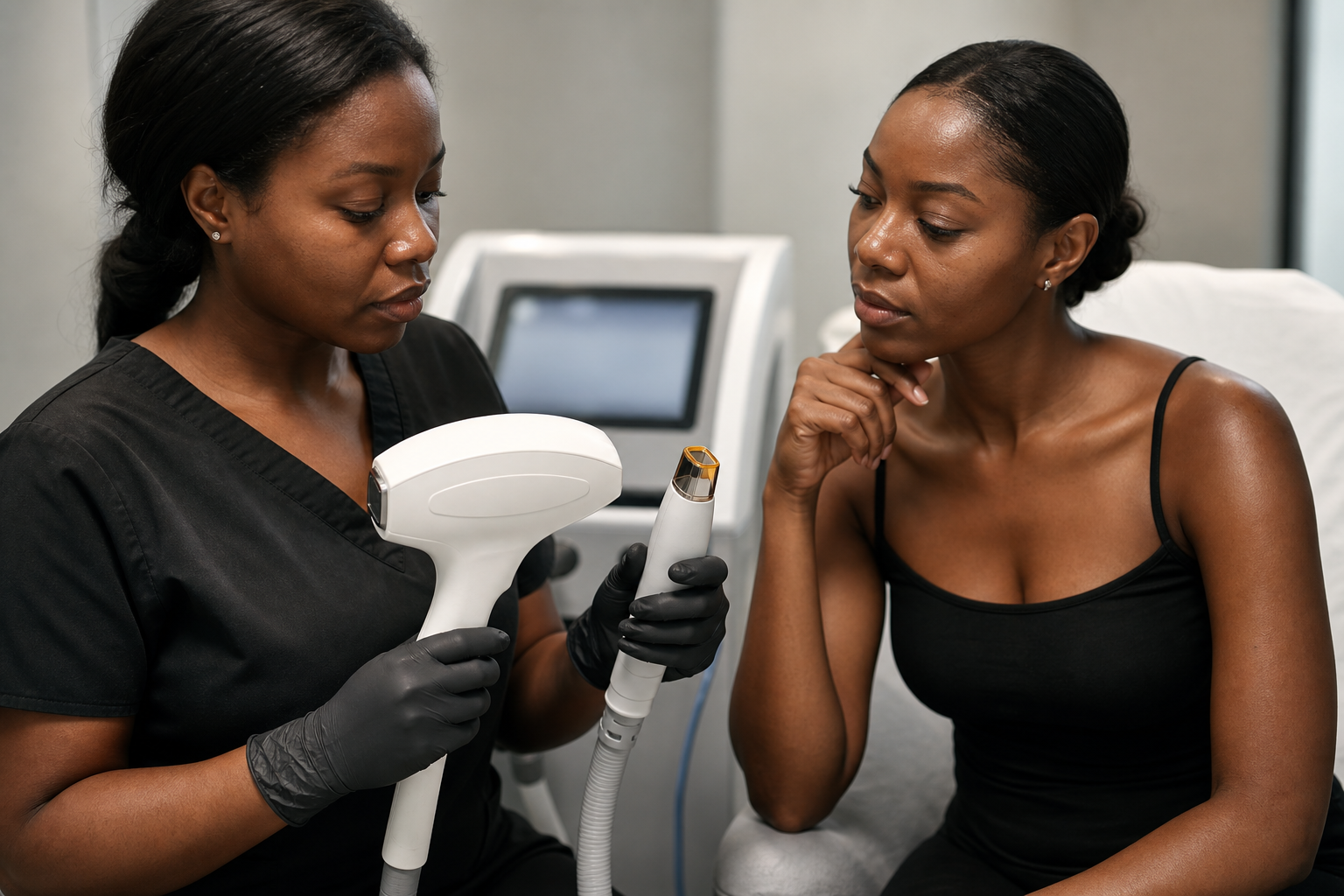
Choosing the right laser for darker skin tones is a nuanced and critical aspect of dermatological and aesthetic laser treatments. As interest in laser hair removal and other skin rejuvenation procedures grows among individuals of all skin types, understanding which lasers are suitable for darker skin is essential. This topic is particularly relevant for Fitzpatrick skin types IV, V, and VI, where increased melanin concentration presents unique challenges to safe and effective laser application.
This editorial explores the key considerations behind selecting lasers that are appropriate for darker phototypes, examining the physical principles involved, technological options available, and clinical factors essential for minimizing risks while optimizing outcomes. It is intended for patients seeking safe treatment options, as well as practitioners aiming to deepen their understanding of how laser parameters can be adapted to ensure both efficacy and safety in darker skin.
Laser treatments such as hair removal, pigmentation correction, and vascular lesion therapy have become increasingly sophisticated, yet the potential for adverse effects like hyperpigmentation, hypopigmentation, or burns remains higher in darker skin if the wrong laser or inappropriate settings are used. Advances like the long-pulsed 1064 nm Nd:YAG laser have revolutionized approaches to these concerns, but no single device universally suits every case. Professional experience, careful assessment, and individualized protocols remain paramount.
What makes laser treatment of darker skin different?
Darker skin naturally contains higher levels of melanin within the epidermis. Melanin acts as a natural protector against ultraviolet radiation but also alters how laser energy interacts with the skin. Since melanin serves as a key chromophore absorbing light energy, lasers targeting melanin in hair follicles for hair removal or pigmented lesions must be carefully calibrated to avoid excessive absorption by the epidermal melanin.
When laser energy is absorbed by the epidermis instead of selectively targeting the hair follicle or lesion, it can lead to overheating of skin cells. This overheating may manifest as immediate side-effects like redness or blistering and more long-term consequences such as post-inflammatory hyperpigmentation or hypopigmentation, which can be especially noticeable on darker skin types.
Therefore, safely performing laser treatments on darker skin requires using wavelengths and pulse durations that penetrate deeper into the dermis to target structures like hair follicles while minimizing energy absorption in the epidermis.
Why are longer wavelengths like 1064 nm Nd:YAG lasers considered more suitable for darker skin?
Among the various laser types used in aesthetics, the long-pulsed 1064 nm Nd:YAG laser has gained prominence when treating darker skin. This is largely because the 1064 nm wavelength offers relatively low absorption by melanin in the epidermis compared to shorter wavelengths. It penetrates deeper into the skin, reaching hair follicles more selectively while sparing the upper skin layers from excessive heat.
The longer pulse durations often employed with Nd:YAG systems allow gradual heating of the follicle, reducing the risk of thermal injury to the surrounding skin. Combining these parameters with advanced cooling mechanisms further protects the epidermis during treatment.
Importantly, this approach does not guarantee outcomes for all patients but provides a safety margin that many practitioners leverage to handle the challenges posed by higher skin pigmentation safely.
How do diode lasers compare, and are they suitable for darker skin types?
Diode lasers typically emit in the 800–940 nm range, which has high absorption by melanin, making them highly effective for hair removal in lighter skin. However, this characteristic also means they bear a higher risk of affecting epidermal melanin in darker skin, potentially increasing adverse effects if parameters are not meticulously set.
With appropriate pulse durations, energy levels, and efficient cooling, modern diode laser systems have adapted to treat darker skin types successfully. Their effectiveness depends on the specific device's capabilities and the operator's expertise in optimizing settings for safety.
Given the variability among diode lasers and the skin's response, diode lasers are neither universally favored nor contraindicated for darker skin but require thorough individual evaluation and often a test patch to assess reaction.
What role do hair pigment and follicle depth play in laser selection?
The characteristics of the hair itself significantly impact the effectiveness of laser hair removal. Darker, thicker hairs contain more melanin and absorb laser energy more efficiently, facilitating successful follicular destruction. Conversely, lighter or finer hairs absorb less energy and respond less predictably to treatment.
Follicle depth varies by anatomical site; in some areas of the body, follicles sit deeper beneath the surface. Long wavelengths with deeper skin penetration, such as the 1064 nm Nd:YAG laser, are often more effective in targeting follicles located further from the epidermis, often present in areas like legs or underarms.
Matching the laser wavelength with follicle depth and hair pigmentation allows for maximizing treatment efficacy and minimizing collateral skin damage.
Why are pulse duration and cooling crucial in treating darker skin?
Pulse duration—the length of time the laser energy is delivered—matters critically for energy distribution in the skin. Longer pulses permit gradual heating of the target without overheating the epidermis. Short pulse durations, while effective for lighter skin, can cause rapid and less controlled energy absorption, increasing thermal damage risk in darker pigmented skin.
Cooling technologies, such as contact cooling, cryogen sprays, or air cooling, are integral to protecting the skin's surface during treatment. Effective cooling limits epidermal temperature rise, enhancing comfort and reducing risk for burns or pigment alterations.
A balanced combination of appropriate pulse duration and well-designed cooling mechanisms constitutes a fundamental safety strategy in laser treatments involving darker skin tones.
How critical is operator experience in laser treatments for darker skin?
No technology alone ensures safety and positive outcomes in laser treatments; skilled and experienced operators are essential. The practitioner's knowledge influences parameter selection, patient assessment, and management of skin reactions.
Practitioners must carefully evaluate the patient’s skin type, hair characteristics, medical history, and treatment area before initiating therapy. They must calibrate laser settings—energy, pulse duration, spot size—precisely for the individual's needs and monitor skin response throughout the procedure.
Experience also guides when to perform test patches and how to anticipate and manage rare complications or adverse effects, which may be more frequent or severe in darker skin if mishandled.
When and why should test treatments be performed specifically on darker skin?
A test treatment or patch test is a precautionary trial applied to a small skin area before full laser treatment. It allows observation of the patient's immediate and delayed skin response to specific laser parameters.
For darker skin types, where melanin concentration enhances susceptibility to pigmentary changes, a test patch is especially valuable. It can reveal tendencies toward hyperpigmentation, hypopigmentation, or irritation that inform safer parameter adjustments.
Only after a favorable response to the test can a full treatment session be safely planned, minimizing the risk of lasting adverse effects.
What are the common patient concerns and questions regarding laser treatment for darker skin?
Patients frequently inquire about the safety and effectiveness of laser hair removal or skin treatments on darker skin, wondering if their skin tone puts them at higher risk for complications. Questions often focus on which laser devices are safer, how many sessions will be needed, pain levels, possible side effects, and how to select a qualified practitioner.
It is important to clarify that while certain lasers, such as the Nd:YAG 1064 nm, are generally preferred for their safety profile in darker skin, treatment success and safety depend on numerous factors. Individual assessment and treatment customization are indispensable.
Patients should also understand that no laser is universally the “best” for every darker-skinned individual. Communication with a knowledgeable provider and appropriate expectations are key to achieving the best results.
How do skin type and laser parameter adaptations interconnect in effective treatment?
Laser hair removal and other laser therapies require tailored parameters based on skin phototype. Parameters such as fluence (energy density), pulse duration, repetition rate, and spot size are adjusted to optimize follicular heating while safeguarding the epidermis. For darker skin types, lower fluences, longer pulses, and superior cooling are typically employed.
Understanding the Fitzpatrick skin classification aids practitioners in anticipating melanin-mediated light absorption and potential sensitivity. Technological advancements have introduced devices with built-in settings or protocols explicitly designed for darker phototypes, including real-time skin temperature monitoring and dynamic cooling systems.
Successful treatments integrate this knowledge with precise parameter modulation for each session based on patient feedback and observed skin response.


