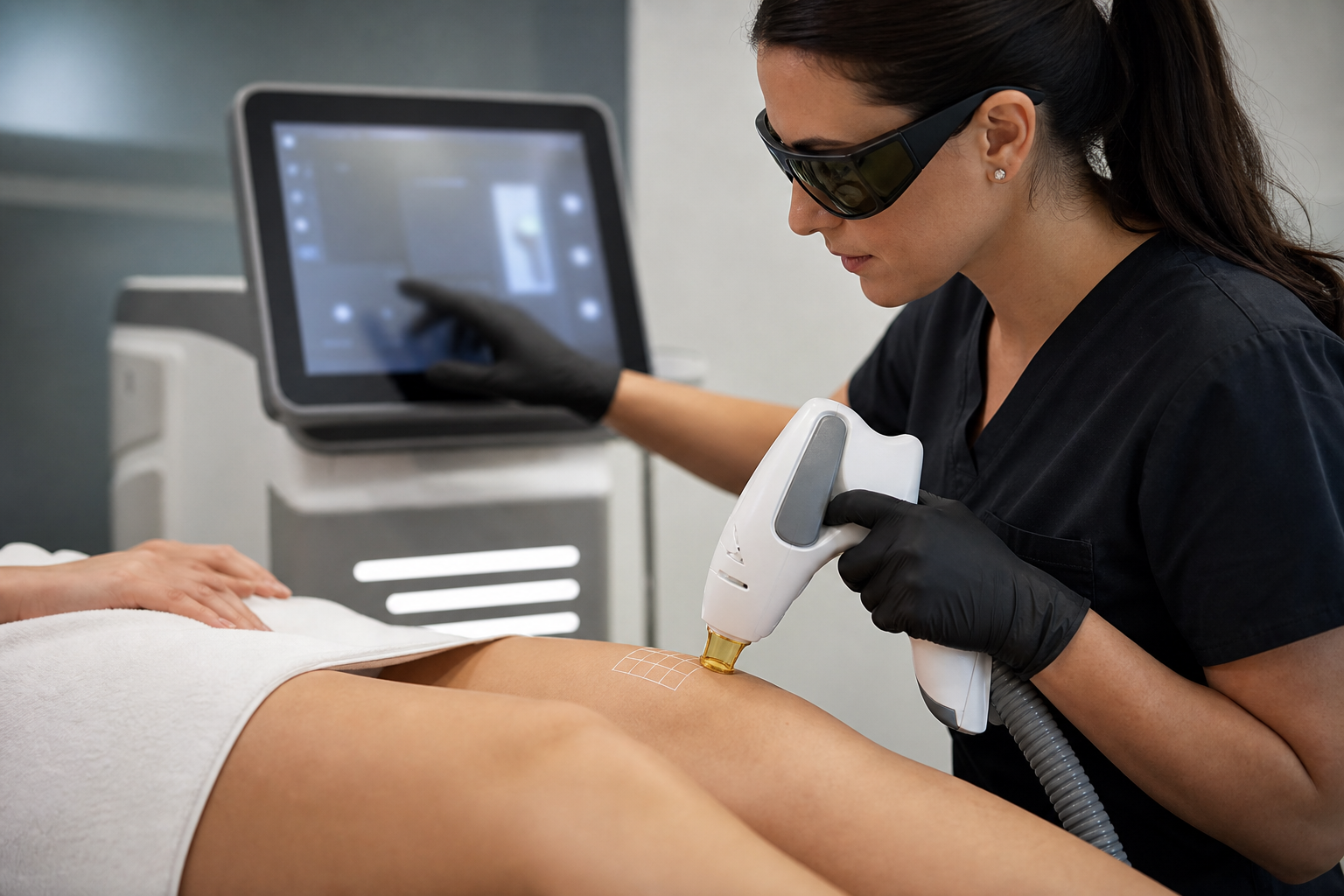
The adaptation of laser settings to individual skin types represents one of the most critical aspects in the realm of aesthetic laser treatments. Whether the intended procedure is laser hair removal, pigmentation correction, or skin rejuvenation, the precise tailoring of parameters to the unique characteristics of a patient’s skin and hair ensures both the efficacy and safety of the treatment. This article is crafted for dermatologists, laser technicians, and informed patients alike, offering a deep-dive explanation of how trained professionals align phototype classifications, current skin pigmentation, hair colour and calibre, and body area considerations with the sophisticated technological specifications of laser devices.
By comprehending the intricate factors involved—from wavelength and fluence to pulse duration, spot size, repetition rate, delivery mode, and cooling mechanisms—readers will appreciate the complexity behind what appears on the surface as a straightforward laser procedure. Moreover, it emphasizes why an identical Fitzpatrick skin type does not necessarily imply uniform laser settings, underscoring the need for individualization based on a dynamic clinical evaluation. Knowledge of clinical endpoints, patch testing, and meticulous documentation all emerge as indispensable tools for ensuring optimal treatment outcomes.
This exploration thus is not a manual for self-adjustment or a compilation of numeric setting tables, but rather a conceptual and practical manuscript describing the expert decision-making process behind the scenes—a nuanced orchestration informed by science, technology, and clinical artistry.
Understanding Skin Phototype and Its Role in Laser Parameter Selection
The Fitzpatrick skin phototype scale remains a foundational framework in laser dermatology, classifying skin into six types according to its typical reaction to sun exposure—ranging from very fair (Type I) to very dark (Type VI). This classification provides an initial reference for predicting the skin’s melanin content and its propensity to burn or tan, factors critical to managing laser-tissue interactions safely.
However, relying solely on phototype can be misleading. Actual pigmentation can vary within the same phototype due to environmental influences, hormonal changes, or prior cosmetic treatments. Additionally, the presence of active pigmentation irregularities—such as post-inflammatory hyperpigmentation or melasma—may alter laser absorption profiles significantly. Therefore, practitioners conduct a thorough assessment including visual inspection, patient history, and often, dermoscopic evaluation to appreciate these subtleties.
An accurate understanding of skin colour and condition informs the foundational choice of laser wavelength, since melanin is the primary chromophore targeted in hair removal and pigmentation treatments. Longer wavelengths penetrate deeper and may be safer for darker skin, while shorter wavelengths can be effective but potentially risky if misapplied. This fine balance is central to delivering results devoid of adverse effects like hypopigmentation, burns, or scarring.
How Hair Characteristics Influence Laser Treatment Strategies
The characteristics of hair—its colour, thickness (calibre), and density—play an equally important role in customizing laser parameters. Melanin within the hair shaft and follicle acts as the energy absorber during laser hair removal, so darker and coarser hair generally responds better to a broad range of wavelengths due to higher melanin concentration and better absorption.
Conversely, fine, light-coloured hairs contain less melanin, reducing laser energy absorption and thereby demanding a more tailored approach, often involving specific lasers optimized for these hair types or adjunct technologies. The interaction between hair colour and wavelength means that certain settings might require modification even within the same individual if variation in hair characteristics across body areas exists.
Moreover, large body areas with thick hair may allow for larger spot sizes and higher repetition rates, accelerating treatment time but requiring vigilance to manage heat accumulation. Conversely, sensitive or smaller areas such as the face or bikini line require more precise, delicate settings to avoid side effects while ensuring sufficient energy delivery to effectively target the hair follicles.
Selecting Optimal Laser Parameters: Wavelength, Fluence, and Pulse Duration
The choice of laser wavelength determines how deeply the laser light penetrates the skin and its affinity for melanin absorption versus other chromophores. For example, long-pulsed Nd:YAG lasers emitting at 1064 nm possess reduced melanin absorption but enhanced depth penetration, making them suitable for darker skin types to minimize epidermal damage while targeting follicular structures.
Fluence, measured as energy density (J/cm²), governs the amount of energy deposited on the skin and should be sufficient to thermally damage the target without causing collateral injury. The therapeutic window is narrow and varies by skin and hair type, so initial conservative settings with gradual titration based on skin response are a hallmark of safe practice.
Pulse duration needs matching to thermal relaxation time of the hair follicle. Longer pulse widths suit coarse hair and darker skin by delivering energy more gently and reducing peak temperature spikes, whereas shorter pulses may focus energy more acutely but require caution to avoid damaging surrounding tissue.
Collectively, these parameters demand dynamic interplay: increasing fluence with longer pulses may be safer and more effective for certain phototypes; adjusting wavelength based on hair colour optimizes energy delivery; and continuous assessment during treatment helps refine these variables in real time.
The Technical Nuances of Spot Size, Repetition Rate, Delivery Mode, and Cooling Systems
Spot size influences not only the depth of laser penetration but also treatment efficiency. Larger spots refract less and allow deeper light penetration due to reduced scattering. This is particularly advantageous for thicker hair on larger body areas. Meanwhile, smaller spots enhance precision for delicate or curved regions such as facial contours but require more pulses and time.
Repetition rate, or the number of pulses delivered per second, impacts total treatment duration and skin thermal loading. High repetition rates decrease treatment time but can increase risk of cumulative heat and discomfort. Hence, operators carefully balance speed and patient tolerance, often modifying rates according to area and skin response.
Delivery modes vary between continuous wave, long pulse, quasi-continuous, and pulsed operations, each producing distinct thermal effects. Combined with advanced delivery technologies such as scanning systems or fractional laser patterns, these influence the distribution and concentration of energy, tailoring effects to clinical goals.
Cooling technologies, including contact cooling, cryogen spray, or air cooling, safeguard the epidermis by dissipating heat, reducing pain and mitigating post-treatment side effects. Effective cooling expands the safety margin of laser treatments, especially important for darker phototypes or sensitive skin, enabling higher fluences without compromising patient comfort or safety.
Clinical Endpoints and the Role of Patch Testing in Ensuring Safe and Efficacious Treatments
Recognizing clinical endpoints—physiological signs that indicate adequate yet safe energy delivery—is an essential clinical skill. For laser hair removal, transient perifollicular oedema or slight erythema often signals successful follicular heating without epidermal damage. Absence of these signs may imply inadequate fluence, whereas excessive erythema, blistering, or pigmentary changes necessitate immediate adjustment or cessation.
Patch testing, involving trial applications on small skin areas, is fundamental for individualized treatment calibration. It allows practitioners to monitor initial skin responses—such as irritation, pigment changes, or sensitivity—to fine-tune laser parameters before proceeding to the full treatment. Documentation of these reactions not only aids ongoing patient management but contributes to the broader knowledge base informing future protocols.
Regular assessment of documented responses fosters a feedback loop that refines precision and safety with every session, acknowledging that skin behavior may evolve due to cumulative effects or external factors.
Why Identical Phototypes Require Distinct Laser Settings: The Case for Individualization
While the Fitzpatrick classification provides a useful starting point, it does not capture the full spectrum of individual variability that influences laser interaction with skin. Two patients categorized as Type III may differ markedly in epidermal thickness, distribution of superficial melanin, vascularity, or even the presence of tattoos or scars, all affecting laser safety and efficacy.
Moreover, environmental factors such as recent sun exposure, tanning, or skincare regimens can alter melanin levels transiently, creating fluctuating risk profiles. Seasonal variations may also necessitate adjustment of parameters to maintain optimal outcomes without compromising safety.
The emotional and subjective perception of pain, along with patient skin sensitivity, further influence procedural modifications. Consequently, a rigid, textbook approach is inadequate, and experienced clinicians rely on continuous real-time evaluation, clinical judgment, and patient feedback to sensibly modulate treatment settings.


