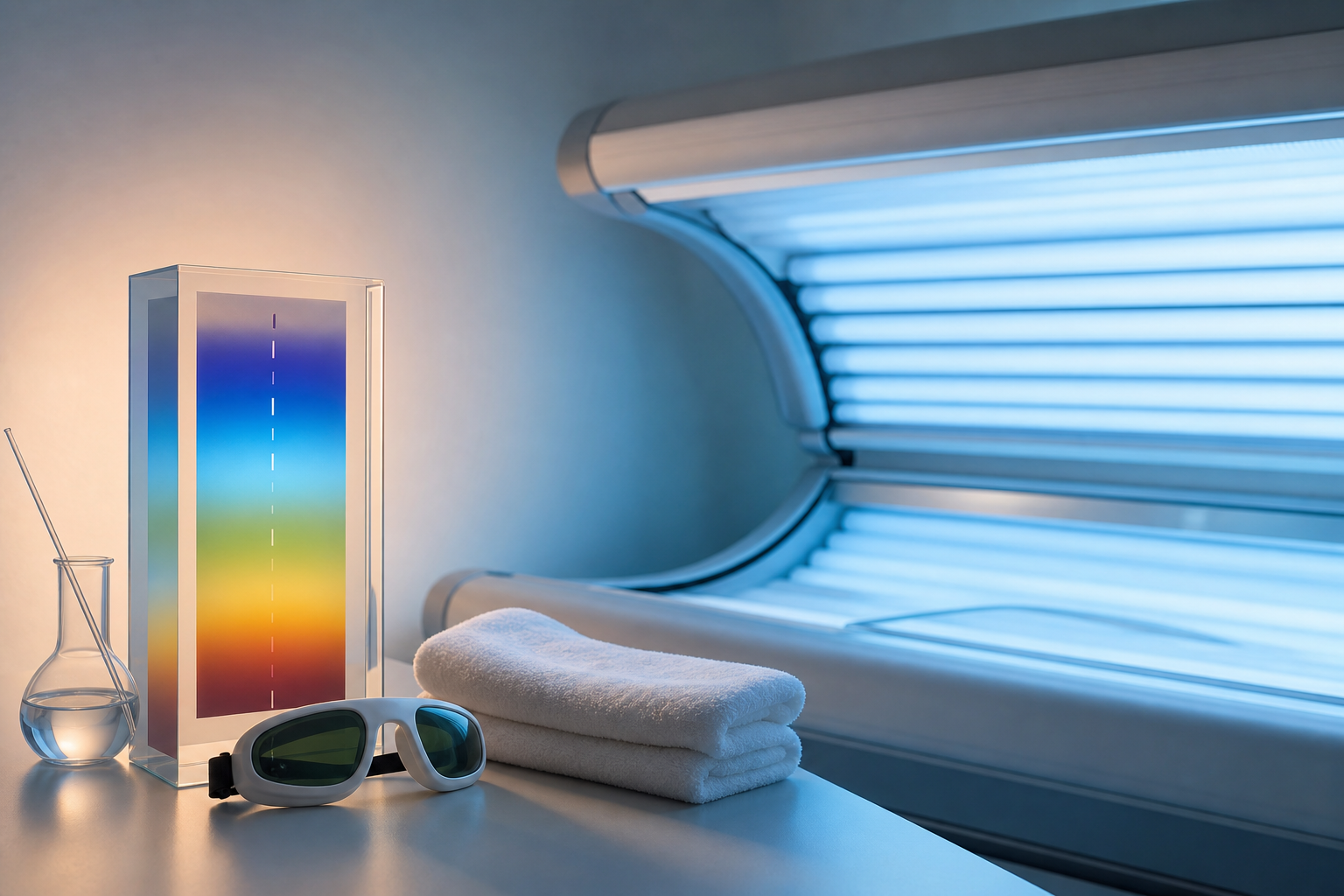
The interaction between sunbeds and individuals with very fair skin phototypes presents a topic of considerable medical and public health importance. This article focuses on explaining how the use of sunbeds affects those with very fair skin—typically classified as Fitzpatrick phototypes I and II—who are naturally more vulnerable to ultraviolet (UV) radiation. Given the evolving scientific understanding that there is no known safe threshold for UV exposure, this piece aims to provide detailed, evidence-based insights that clarify the risks, dispel common misconceptions, and guide readers toward balanced awareness. It is intended for readers with very fair skin considering sunbed use, healthcare professionals advising them, as well as anyone interested in the intersection of skin type and tanning technologies.
Fair-skinned individuals often wonder whether tanning via artificial UV sources like sunbeds is a safe or prudent option for achieving a tanned appearance. This curiosity is understandable given social norms and aesthetic preferences. However, mounting scientific evidence, including authoritative classifications by the International Agency for Research on Cancer (IARC), firmly places UV radiation—including that emitted by sunbeds—in Group 1 carcinogens, signifying established carcinogenicity to humans. Such declarations reinforce the absence of a "safe" exposure limit and underline the particular concerns for those with less melanin-based photoprotection.
Understanding the relationship between sunbeds and very fair skin is crucial because this demographic is disproportionately susceptible to UV damage, which amplifies both immediate and long-term risks. This article will examine the defining features of very fair skin phototypes, elaborate on why no safe UV dose exists, detail the health risks specific to this group when using sunbeds, discuss scenarios where sunbed use is contraindicated, and highlight safer alternatives for achieving a tanned look. References to related topics within the broader context of sunbed health implications provide an integrated view that aligns with best practices in skin care and oncology prevention.
Defining Very Fair Skin Phototypes and Their Biological Response to Sunbeds
Very fair skin phototypes, notably types I and II on the Fitzpatrick scale, possess fundamentally low levels of melanin pigmentation, which serves as a natural defense against ultraviolet radiation. Individuals exhibiting these phototypes typically have pale, often translucent skin that burns easily and rarely tans naturally. Accompanying characteristics frequently include light-colored eyes and hair, such as blond or red shades, which correlate genetically with lower melanin production.
Melanin plays a crucial protective role by absorbing and dissipating UV radiation, reducing DNA damage within skin cells. For those with very fair skin, the diminished melanin content results in increased vulnerability to the effects of both UVA and UVB radiation, which are emitted not only by natural sunlight but also by artificial sources like sunbeds. The higher susceptibility translates to a greater risk of acute injuries such as sunburn and chronic consequences including photoaging and carcinogenesis.
Sunbeds often emit UV radiation at intensities and spectral compositions that differ significantly from ambient sunlight, with a pronounced portion in the UVA range and variable UVB content. This can create unpredictable interactions with sensitive skin that lacks adequate melanin shielding, as seen in very fair phototypes. Consequently, users with such skin types may experience exaggerated adverse skin reactions, highlighting the need for heightened caution and informed decision-making.
Why There Is No Safe UV Exposure Threshold with Sunbeds
Scientific consensus, supported by decades of epidemiological and molecular research, conclusively rejects the notion of a "safe" UV dose when it comes to skin exposure. The International Agency for Research on Cancer (IARC), a branch of the World Health Organization (WHO), classifies UV radiation—including that from sunbeds—as a Group 1 human carcinogen. This top-tier classification acknowledges incontrovertible evidence linking UV radiation to various forms of skin cancer, including melanoma, basal cell carcinoma, and squamous cell carcinoma.
The carcinogenicity of UV radiation stems from its ability to inflict direct and indirect DNA damage in skin cells. These DNA lesions, such as cyclobutane pyrimidine dimers and oxidative base modifications, interfere with cellular replication fidelity. While normal cells have repair mechanisms, repeated or intense UV exposure can overwhelm these systems, enabling mutations to accumulate. Over time, mutations in oncogenes and tumor suppressor genes can trigger malignant transformation.
Crucially, even low levels of UV exposure can initiate these molecular events. Thus, the absence of a threshold refers to the inability to define a minimal dose below which no damage occurs. This has profound implications for sunbed users, especially those with very fair skin, since any UV exposure carries intrinsic risks. Moreover, sunbeds may emit UV doses several times stronger than midday sun in some regions, exacerbating potential harm.
Health Risks Specific to Very Fair-Skinned Sunbed Users
Individuals with very fair skin face multiple health risks from sunbed usage, accentuated by their heightened photosensitivity. The most immediate risk is sunburn, which in this context manifests as UV-induced erythema. This not only causes discomfort, pain, and inflammation but also represents direct cellular damage. Recurrent episodes of sunburn cumulatively increase cancer risk by promoting genetic mutations.
Long-term exposure accentuates photoaging—a collection of structural and functional skin changes including fine lines, uneven pigmentation, loss of elasticity, and rough texture. Fair skin, with less melanin-mediated defense, experiences these changes earlier and more severely, undermining skin appearance and integrity.
The most serious health consequence linked to sunbed use in very fair skin individuals is melanoma, an aggressive skin cancer originating from melanocytes. Epidemiological studies have demonstrated that sunbed use increases the risk of melanoma development, especially when exposure begins at a young age or is frequent. Furthermore, basal cell carcinoma and squamous cell carcinoma incidence also escalates with artificial UV exposure.
Given these risks, dermatologists emphasize vigilant skin monitoring, professional skin examinations, and education for fair-skinned individuals who use or consider sunbeds. Individuals with numerous moles or a family history of melanoma warrant particular care.
Clinical Circumstances Under Which Sunbed Use Should Be Avoided
Certain health conditions and situations heighten the dangers of UV exposure from sunbeds, particularly for people with very fair skin. Photosensitive skin disorders, including but not limited to rosacea, eczema, and psoriasis, can be exacerbated by UV radiation, worsening symptoms and complicating management For more comprehensive guidance, individuals can consult the resource Sunbeds and Photosensitive Skin Conditions.
Pregnancy introduces hormonal changes that can affect skin pigmentation. UV exposure during this period may provoke additional hyperpigmentation or melasma, which can be long-lasting. The article Sunbeds and Pregnancy: Additional Pigmentation Changes further elaborates on these considerations.
Multiple medications increase sensitivity to light, including certain antibiotics, diuretics, and antidepressants. When combined with sunbed UV exposure, these drugs may lead to exaggerated skin reactions or damage. Before sunbed use, consulting a healthcare provider or pharmacist is essential to review possible drug interactions; see Medicines That Can Increase Sensitivity to Light for examples.
Further, individuals with a prior diagnosis of skin cancer face significantly increased risks if exposed to further UV radiation and should abstain from sunbed use to avoid tumor recurrence or new cancers.
Safe Alternatives to Sunbeds for Achieving a Tanned Appearance
For those with very fair skin seeking the aesthetic of a tan without incurring UV-related risks, several viable alternatives exist. Self-tanning products formulated with dihydroxyacetone (DHA) are widely available and offer temporary pigmentation by chemically reacting with amino acids in the stratum corneum. These products provide a tanned look without any UV exposure, thereby eliminating cancer risk.
Modern formulations of self-tanners feature improved color consistency, fast-drying textures, and long-lasting effects, facilitating natural appearance and user convenience. Additionally, spray tanning booths using DHA provide even application in professional settings. These approaches are generally safe when used as directed and do not induce photosensitivity.
Adopting such UV-free tanning alternatives is particularly advisable for individuals with very fair skin, reinforcing skin health preservation while satisfying cosmetic preferences.
Recognizing Signs of UV Damage and When to Seek Medical Advice
Even with precautions, exposure to sunbed UV rays may cause symptoms that merit clinical evaluation, especially in highly sensitive fair skin. Persistent redness, blistering, peeling, or pain following sunbed sessions signal acute damage. Moreover, any new, enlarging, or morphologically changing moles or skin lesions must be promptly examined by a dermatologist.
Individuals should be alert to unusual skin symptoms such as itching, ulceration, or color changes on preexisting spots, which could mark early malignancy. Regular skin self-examinations combined with professional dermatologic follow-ups form a critical component of effective skin cancer prevention and early detection.
The Importance of Personalized Medical Consultation Before Using Sunbeds
Given the complex interplay between skin phototype, individual health history, genetic factors, medication use, and environmental exposures, personalized medical advice is indispensable when considering sunbed use. A dermatologist can provide tailored risk assessments and recommend appropriate skin care strategies For further guidance on individual variability in sunbed risks, the article Sunbeds and Individual Risk Factors presents comprehensive insights.
Such consultations gain even greater significance for those with very fair skin, who may require more stringent protective measures or alternative approaches altogether. Engaging with healthcare professionals ensures that decisions regarding artificial tanning are made with full awareness and clinical oversight.


