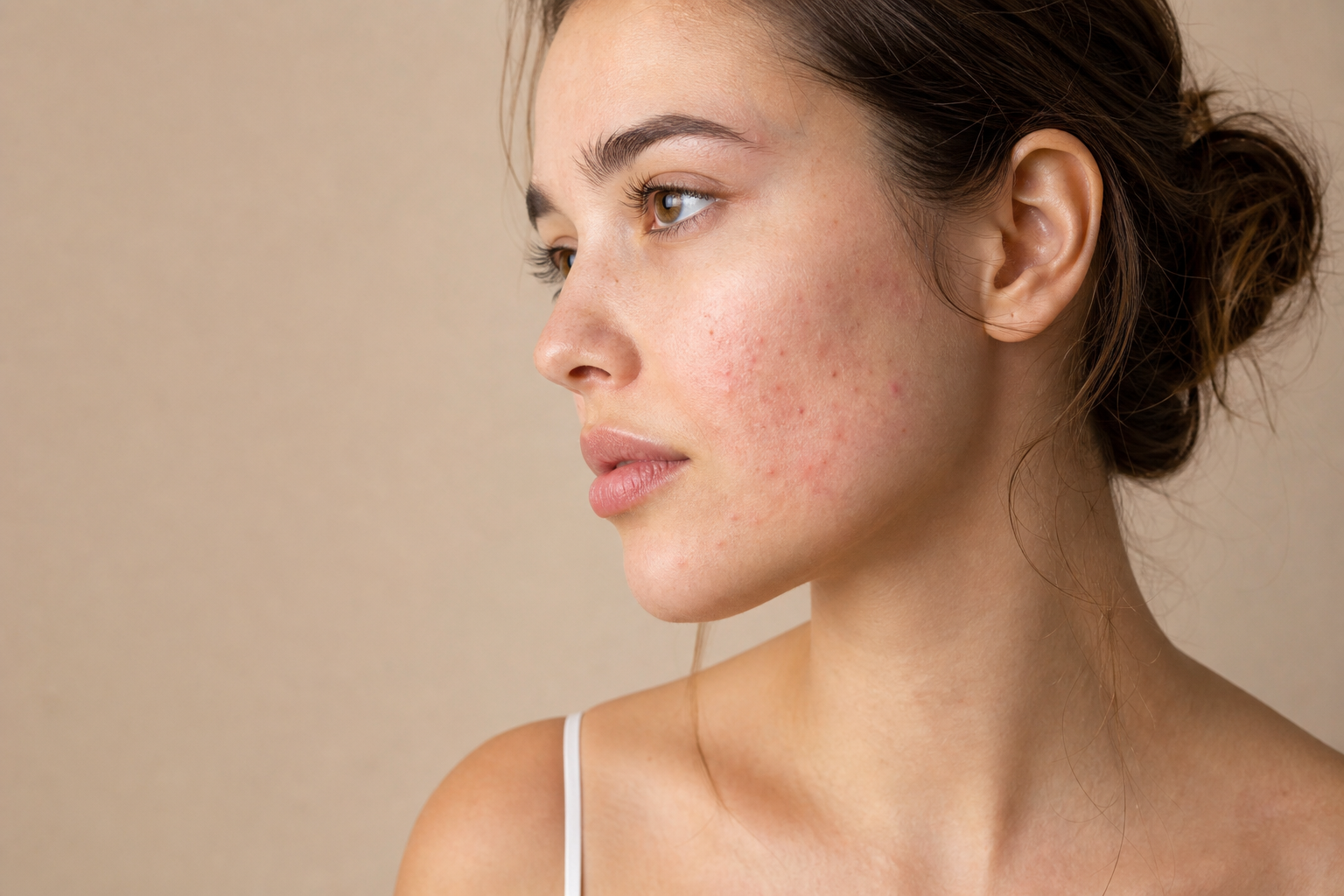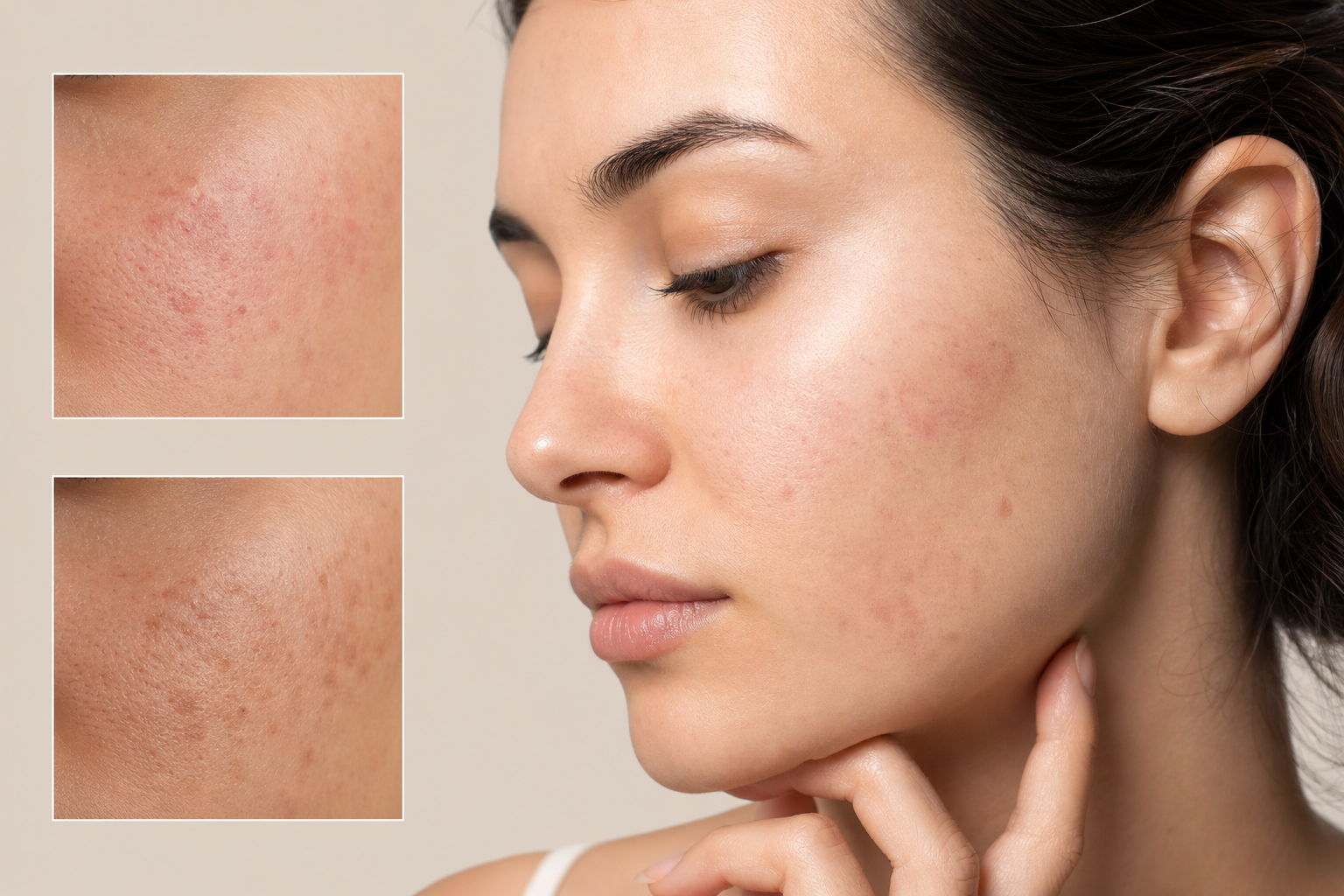
Acne does not always stop being a concern once the active breakout has healed. Red, pink, purple, brown, or greyish marks may remain for weeks or months, and in some cases even longer. Although these marks are often referred to as acne scars, most are not true scars. They are temporary changes in skin colour caused by inflammation.
Distinguishing between red marks, dark spots, and true acne scars is essential because each develops differently and requires a different approach. A product that improves brown pigmentation may have little effect on persistent redness, while topical skincare cannot completely remove deep, indented scars.
Why Do Post-Acne Marks Develop?
Every inflamed spot causes a small inflammatory response within the skin. Once the breakout settles, the skin needs time to repair the affected tissue, regulate pigment production, and restore the small blood vessels in the area.
During this healing process, a visible mark may remain where the blemish once appeared.
The likelihood of developing persistent marks increases with:
Picking, squeezing, or scratching spots
Deep, painful, or long-lasting inflammation
Sun exposure without adequate protection
Aggressive exfoliation
Excessive use of acids or retinoids
A damaged skin barrier
Poorly combined active ingredients
A natural tendency towards pigmentation
New breakouts repeatedly developing in the same area
The deeper and more intense the inflammation, the greater the chance of a noticeable mark remaining. Squeezing a spot can further damage the surrounding tissue, push inflammation deeper into the skin, and increase the risk of true scarring.
Red Marks, Dark Spots, and Acne Scars Are Not the Same
The first step towards choosing an effective treatment is identifying the type of mark. Colour and skin texture usually provide the most important clues.
Red marks after acne
Flat red, pink, or purple marks are commonly known as post-inflammatory erythema, or PIE. They develop because inflammation affects the small blood vessels close to the surface of the skin.
These marks do not normally alter the skin’s texture. They may appear bright red or pink on lighter skin tones and deeper red or purple on medium and darker complexions.
If a red mark temporarily becomes lighter when gentle pressure is applied, it may indicate that blood vessels are contributing to its appearance. However, this simple test cannot provide a definite diagnosis, especially when redness and pigmentation are present at the same time.
Post-inflammatory redness may fade naturally, but the process can take several months. Sun exposure, heat, irritation, harsh exfoliation, and recurring breakouts may prolong its appearance.
Dark spots after acne
Brown, grey-brown, or darker patches are generally classified as post-inflammatory hyperpigmentation, or PIH. They develop when inflammation stimulates excess melanin production.
These marks are also flat, but unlike vascular redness, they do not usually become lighter when pressed. Post-inflammatory hyperpigmentation can affect every skin tone, although it is often more pronounced and persistent in medium to deep complexions.
UV exposure can make these marks darker and more difficult to treat. Visible light may also contribute to persistent pigmentation in certain skin tones, making daily sun protection a central part of any treatment plan.
True acne scars
A true scar changes the texture and structure of the skin. It may appear indented, raised, firm, or uneven.
Atrophic or indented scars include:
Ice-pick scars, which are narrow and deep
Boxcar scars, which are wider with more defined edges
Rolling scars, which create a wavy or uneven skin surface
Raised hypertrophic and keloid scars develop when the skin produces excessive scar tissue. They are more common on the chest, shoulders, back, and jawline, although they may occur elsewhere.
Skincare products can improve hydration, pigmentation, and the overall appearance of the skin, but they cannot completely remove deep structural scars. These usually require professionally selected treatments.
The Foundation of an Effective Skincare Routine
The best results do not necessarily come from using the largest number of products. Correctly identifying the problem, controlling active acne, and following a consistent routine are far more important.
A basic routine should include:
Gentle cleansing
One carefully selected active treatment
A moisturiser suitable for the skin type
Daily broad-spectrum sun protection
If new breakouts are still developing, controlling active acne should be the priority. Otherwise, old marks will be treated while new ones continue to appear, making progress difficult to see.
Daily sun protection
Broad-spectrum sunscreen with at least SPF 30, and preferably SPF 50, is one of the most important steps for treating post-acne pigmentation. It should be applied every morning in an adequate amount, regardless of the season.
Sunscreen should be reapplied during prolonged outdoor exposure. For persistent pigmentation, tinted formulas containing iron oxides may provide additional protection against visible light.
Sunscreen will not remove existing marks overnight. Its role is to prevent further darkening and create the conditions in which the skin and other treatments can gradually improve the discolouration.
Azelaic acid
Azelaic acid is particularly useful when acne, redness, and dark marks are present at the same time. It can help calm inflammation, support a more even complexion, and reduce the likelihood of new breakouts.
Although it is generally well tolerated, azelaic acid may initially cause mild tingling, dryness, or sensitivity. It should be introduced gradually and supported with a suitable moisturiser.
Niacinamide
Niacinamide can strengthen the skin barrier, help regulate oil production, and gradually improve uneven skin tone. Very high concentrations are not always necessary. Strong formulas may cause flushing or irritation in sensitive skin.
Retinoids
Retinoids support skin renewal, help prevent clogged pores, and may gradually reduce post-inflammatory pigmentation. They are generally introduced slowly and used as part of an evening routine.
Using a retinoid more frequently does not automatically produce faster results. Excessive use may cause peeling, burning, dryness, and barrier damage, potentially making redness and pigmentation appear worse.
Retinoids should not be used during pregnancy. Anyone who is pregnant, breastfeeding, or planning a pregnancy should seek professional advice before using active skincare ingredients.
Vitamin C and pigmentation-targeting ingredients
Vitamin C may help brighten uneven skin tone while providing antioxidant support. The stability and tolerability of the formulation are more important than choosing the highest available concentration.
Other ingredients used for dark marks include tranexamic acid, alpha-arbutin, and compounds that influence melanin production or distribution.
Hydroquinone may be effective for certain forms of hyperpigmentation, but it should only be used under professional supervision and in accordance with local regulations.
Exfoliating acids
Alpha-hydroxy acids, such as glycolic and lactic acid, may help improve superficial pigmentation and rough texture. Salicylic acid is particularly useful for oily skin, clogged pores, blackheads, and active acne.
A common mistake is combining several exfoliating acids with a retinoid, strong vitamin C product, and additional physical exfoliation. This can lead to chronic irritation and make post-acne marks appear more prominent.
The skin needs controlled renewal, not constant peeling.
Professional Treatments for Red and Dark Post-Acne Marks
Professional treatment should be selected according to the dominant concern, skin tone, current acne activity, sensitivity, and previous reactions. There is no single procedure that works equally well for every type of post-acne mark.
Treatments for red marks
When redness is the main concern, treatments that target blood vessels may offer better results. Depending on the skin assessment, certain vascular lasers or intense pulsed light treatments may be considered.
These procedures are not suitable for every person or every skin tone. Treatment settings must be carefully selected to minimise the risk of burns, prolonged redness, and post-treatment pigmentation.
Chemical peels may improve the overall appearance and texture of the skin, but they do not target blood vessels in the same way as vascular treatments.
Treatments for dark spots
Superficial chemical peels may help accelerate the improvement of uneven pigmentation, particularly when combined with an appropriate home routine and consistent sun protection.
Certain laser and light-based treatments may also improve pigmentation, but they require careful assessment. In deeper skin tones, unsuitable devices or excessive treatment settings can trigger additional pigmentation instead of reducing it.
A more aggressive treatment is not necessarily a more effective treatment. With post-inflammatory hyperpigmentation, calming inflammation and stabilising the skin are often more important than attempting to remove the pigment in a single session.
Treatments for acne scars
Indented acne scars may be treated with procedures such as microneedling, fractional laser resurfacing, subcision, medical chemical techniques, or a combination of treatments.
The correct method depends on the scar type. Narrow, deep scars are not treated in the same way as rolling scars or wider depressions with clearly defined edges.
A single procedure rarely addresses every scar. The most successful plans are usually individualised and may combine several techniques over multiple sessions.
Common Mistakes That Make Post-Acne Marks Last Longer
One of the most frequent mistakes is trying to remove marks as quickly as possible by using too many active ingredients at once. When the skin becomes dry, inflamed, and sensitive, its ability to recover is compromised and the risk of further discolouration increases.
It is particularly important to avoid:
Picking, squeezing, or scratching spots
Daily use of harsh exfoliants
Abrasive brushes and facial scrubs
Applying lemon juice, alcohol, or toothpaste
Combining several strong acids
Introducing retinoids too quickly
Using powerful bleaching products without supervision
Undergoing aggressive treatments on recently tanned skin
Neglecting daily sun protection
Constantly changing products can also make progress difficult to assess. Active ingredients need time to work, and the skin benefits from consistency. If the routine changes every few days, it becomes almost impossible to determine what is helping and what is causing irritation.