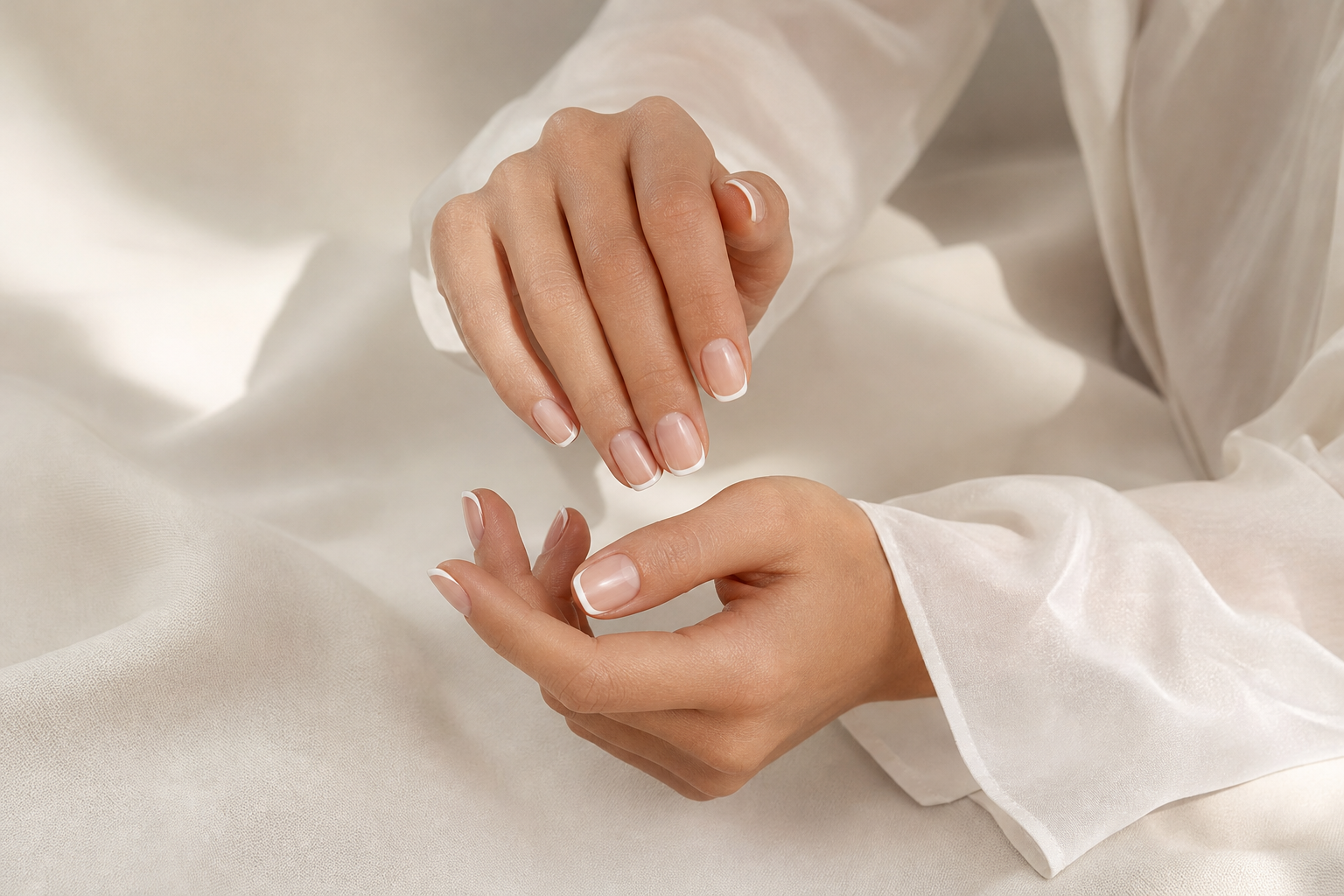
The Micro French Manicure embodies a refined reinterpretation of the timeless French manicure, crafted to suit the sensibilities of today’s clean-girl and minimalist beauty enthusiasts. Distinguished by its delicately thin, precise lines gracing the tip of the nails, this style strikes a harmonious balance between subtlety and elegance. It caters to individuals who cherish understated sophistication, providing a polished, modern look that complements both short and long nails without overwhelming their natural form.
This innovative approach to the classic French manicure emphasizes finesse over boldness. Instead of prominently wide white tips, the micro French manicure features minimalistic lines, often just one to two millimeters in width, that accentuate the nail's natural shape. It fits seamlessly within the current trends favoring neutral palettes, natural finishes like sheer pink and soap nails, and minimalist nail art that underscores well-groomed simplicity.
For those invested in clean-girl and minimalist manicure trends, understanding the subtle artistry and technique behind micro French manicure is essential. The style not only enhances nail aesthetics but also integrates functionality through easier maintenance and compatibility with various nail lengths and shapes. This detailed guide explores the technique’s execution, its adaptability, safety considerations, durability, and its place within modern manicure movements, providing a thorough insight for anyone considering adopting this delicate yet chic look.
Precision in Crafting the Micro French Manicure
The defining characteristic of the micro French manicure lies in the meticulous application of ultra-thin lines along the nail’s edge. Unlike traditional French manicures, which often showcase bold, prominently curved white tips, the micro variant leans toward a restrained, near-linear presentation. Achieving this demands a steady hand, refined tools, and a thoughtful process tailored toward subtlety.
Specialized equipment is central to executing these fine details. Gel polishes are widely favored due to their consistency and long-lasting finish, allowing nail technicians enhanced control over the line’s precision. Thin-tipped brushes and nail art pens made for fine line work enable the creation of continuous, clean edges measuring as little as a millimeter or two in thickness. When using conventional nail lacquer, practitioners often employ striping tape to delineate the line carefully, facilitating sharp edges and preventing bleed.
The procedure begins with thorough nail preparation, including cuticle care, gentle shaping, and surface smoothing to create the ideal canvas. A sheer nude or soft pink base is usually applied to evoke a clean and natural appearance, grounding the slight contrast the micro French line introduces. Rather than stark white, the micro line tends to adopt nuanced colors such as soft milky white, champagne, or even pastel hues to amplify subtlety while maintaining visibility.
More than just the width and color, the line’s shape also varies. While classic French tips feature a smooth, rounded curve, micro French lines often embrace an almost straight edge that closely follows the natural curve of the nail, underscoring modern minimalism with geometric precision. This adjustment enhances the manicure’s understated character without sacrificing refinement.
Customizing the Micro French Manicure for Diverse Nail Lengths and Shapes
A compelling advantage of the micro French style is its versatility across an array of nail forms and lengths. For short nails, it acts as an optical elongator, extending the nail visually by adding a neat, crisp border that redefines the fingertip’s silhouette without imposing excessive design bulk. On these smaller canvases, designers emphasize the line’s delicacy to avoid crowding the nail surface or compromising natural contours.
Long nails benefit differently from the micro French treatment. Here, the slender border avoids overpowering the nail’s length and shape, instead accentuating its natural flow and cleanliness. Whether the nail shape is oval, almond, square, or stiletto, the micro French line is adaptable, varying slightly in curvature or placement to align perfectly with the form’s precision. This compatibility enhances the manicure’s overall harmony and elegance.
For nails that are very short or have uneven edges, micro French requires a nuanced application technique. Lines are carefully tailored to mirror the natural curvature subtly, with minimized color contrast to create unity rather than division. This mindful approach prevents the manicure from appearing congested or out of place, preserving its minimalist essence.
Health and Safety Practices in Micro French Manicure Application
Executing micro French manicures demands not only artistic skill but also adherence to stringent health and safety protocols. A consultative approach is encouraged prior to any treatment, particularly for clients with nail disorders, sensitivities, or dermatological concerns affecting the fingertips and surrounding skin. Nail professionals should assess for conditions such as onycholysis, nail psoriasis, or allergy potential to ingredients found in gels and lacquers.
Maintaining a sterile environment is imperative to minimize infection risks. Tools must be sterilized and disposable implements properly discarded after use. Gentle cuticle treatment techniques are preferred to avoid trauma that might invite bacterial or fungal invasion. Hydrating and strengthening products, including nourishing oils and creams, bolster nail resilience before and after the manicure, especially for those with brittle or fragile nails.
The delicacy intrinsic to micro French lines means that care must be taken to avoid gel spillover or polish smudges that could disrupt the design’s clean finish. Skilled nail technicians mitigate errors through controlled brushwork and the use of high-quality, fast-curing products. Clients are advised to refrain from self-correcting mistakes with harsh removers that can weaken the nail and to seek professional touch-ups instead.
Durability and Maintenance Expectations of the Micro French Manicure
While celebrating finesse and subtlety, micro French manicures also offer pragmatic advantages regarding longevity. When applied using gel systems, these manicures often last between ten and fourteen days with proper care, balancing aesthetic appeal with a manageable upkeep schedule. This duration suits individuals who favor polished yet low-maintenance nail styles.
Successful preservation of the manicure depends heavily on pre-application nail health and post-application care. Maintaining hydration, minimizing aggressive chemical exposure, and gentle handling of nails prolong visual and structural integrity. Regular moisturizing and avoiding actions that cause chipping or peeling help sustain the manicure’s characteristic precision and shine.
It’s important to clarify that the micro French style generally does not accommodate frequent or rapid design changes due to its precise and delicate nature. Clients wishing to frequently alter their nail art or colors might find other manicure styles better suited for shorter wear cycles. Nevertheless, for those seeking a consistent, polished appearance with minimalist flair, this technique achieves an exemplary balance.